Taflarium

In development · Android

Cribbage

The pub table game, and the third of our Ancestral Relics. Six cards each, keep four, throw two to the crib, then lay cards on a count that may not pass 31 and finally count your hand with the starter. It is about four hundred years old and still widely played.

The game

Keep four, throw two, count to 31

Each hand starts with a choice. You are dealt six cards and keep four; the other two go face down into the crib, an extra hand the dealer counts at the end. You want good cards in it when it is yours and poor ones when it is theirs. Then the pack is cut and one card turned up: the starter, which counts with every hand at the show.

Next comes the play. You lay cards one at a time, alternately, calling the running count (court cards ten, the ace one), and the count may not pass 31. Make it exactly fifteen, pair the card just laid, finish a run, or hit 31 exactly, and the points are pegged as soon as the card lands. Say go when nothing fits, and whoever lays the last card takes one for it.

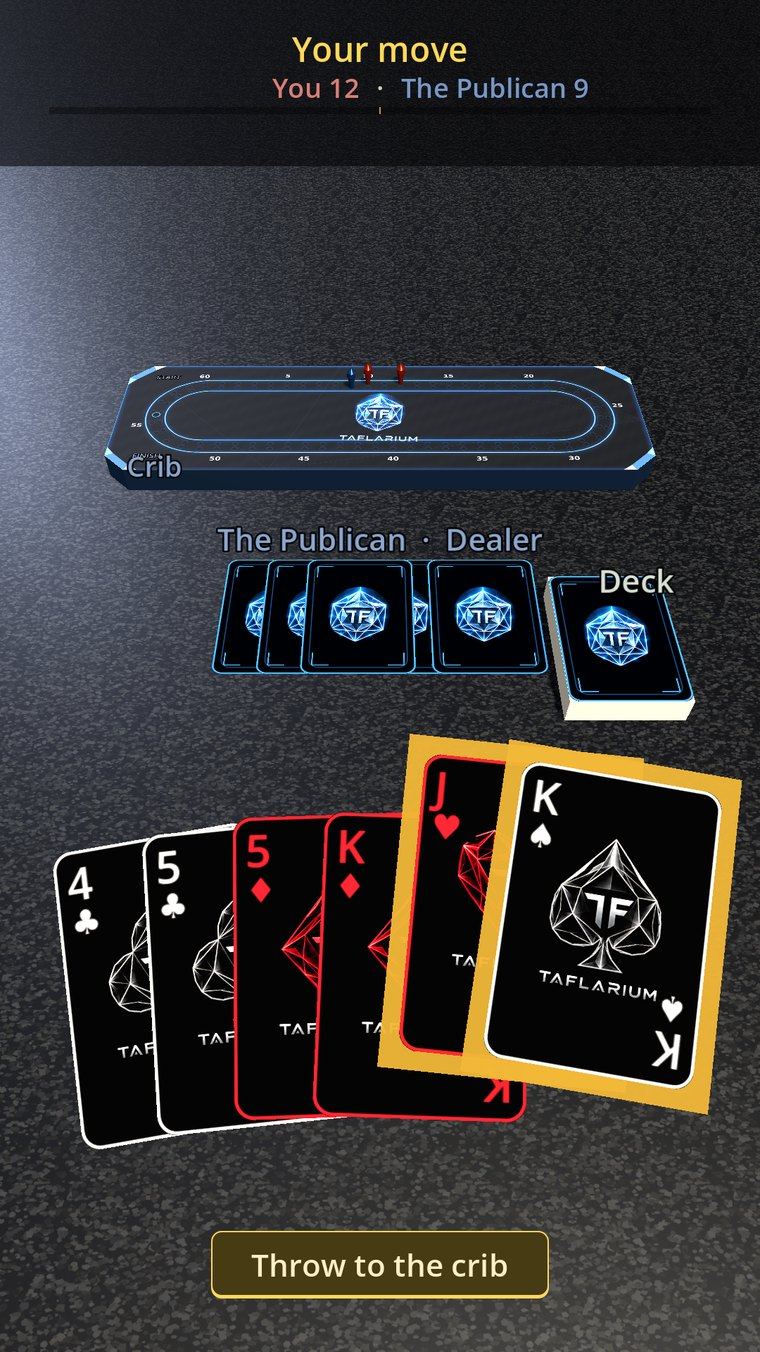
A Cribbage hand of six black-faced cards fanned at the bottom of the screen, the jack of hearts and king of spades raised for the crib, with the Throw to the crib button beneath and the glowing blue pegging board on the table beyond.
Two chosen for the crib, four kept in the hand
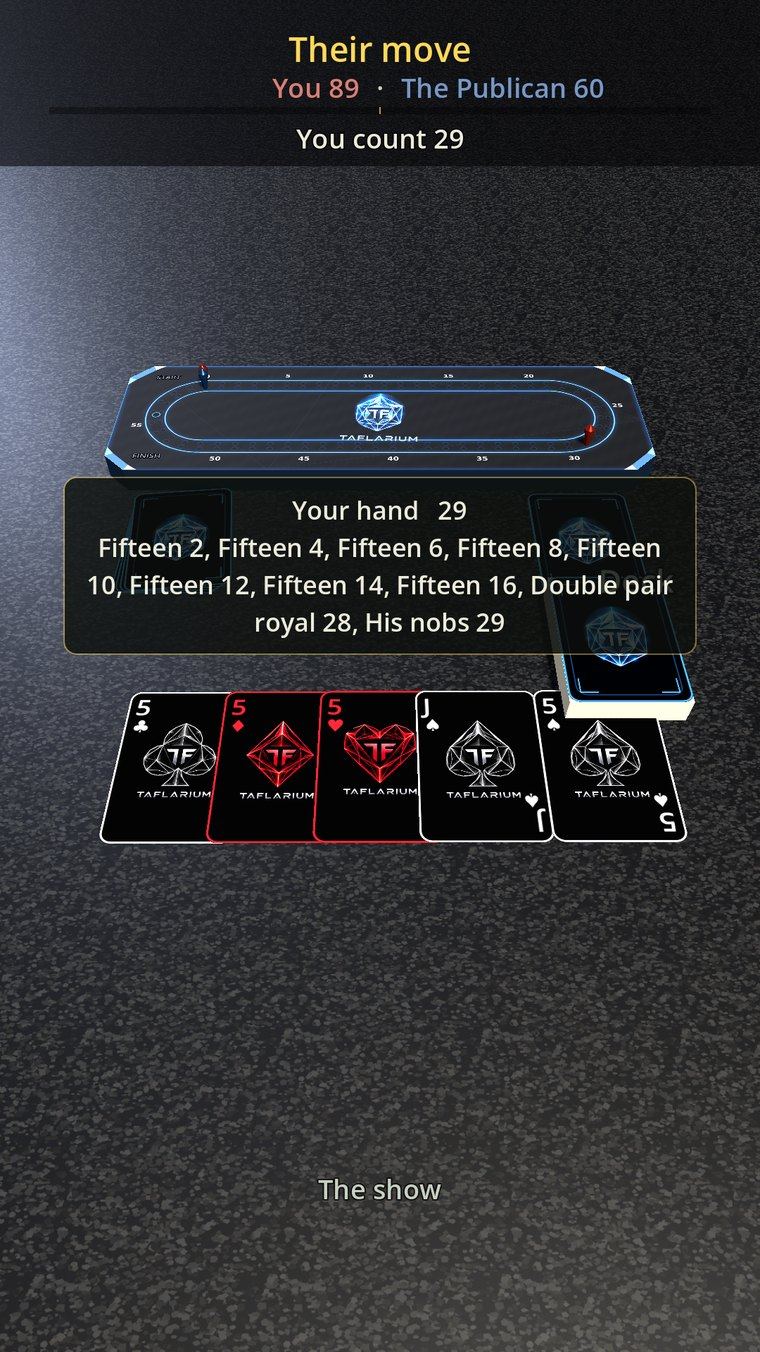
The show in Cribbage: three fives and the jack of spades laid on the table with the five of spades as starter, and a panel above them reading Your hand 29, with every fifteen, the double pair royal and his nobs listed.
The twenty-nine: three fives and a jack, and the fourth five as the starter

The show

Fifteen two, fifteen four, and a pair is six

After the play, each hand is counted with the starter: two for every combination that adds to fifteen, two for a pair, a point a card for a run of three or more, four for a flush, and one for his nobs, the jack of the starter's suit. The non-dealer counts first, then the dealer, then the crib, and the game ends the moment anyone reaches 121, even mid-count.

The game does the counting for you, combination by combination, so nothing is missed and there is no muggins rule to worry about. The scorer behind it was checked against all 12,994,800 hands the pack can deal, and reproduces the published table exactly: four hands score twenty-nine, none scores nineteen.

The table

A lit board and a pack of our own

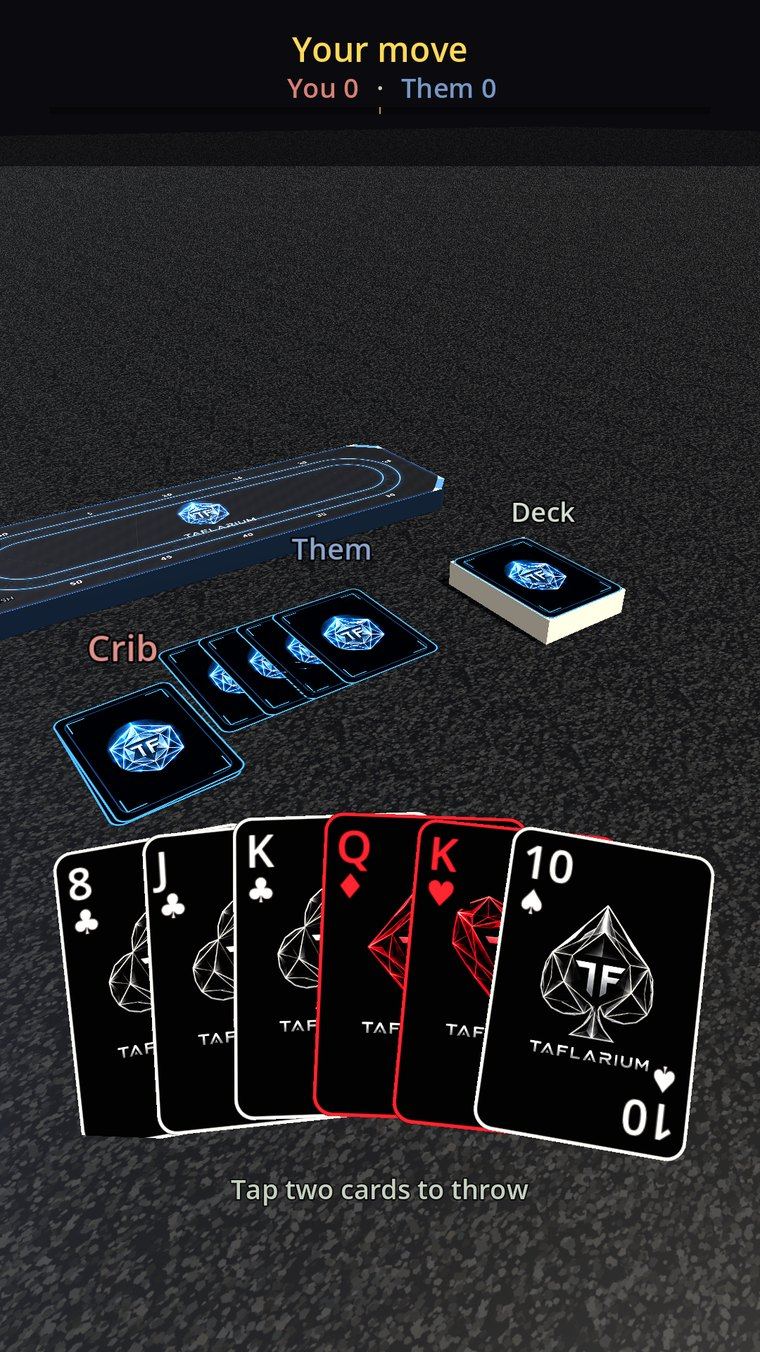
The pegging board is the classic sixty-hole lap, twice round to 121, laid out as a black slab with the two lanes lit. Your peg and theirs are faceted metal in your own colours, and the score line names the sides: you in the colour of your peg and your opponent by name, so you can always see which is yours.

The pack is black-faced, each suit a faceted crystal carrying the house mark, and the whole table sits on forged carbon. Drag anywhere off a card and the table turns; tap a card and it rises from the fan. The cards are 3D objects that are dealt, drawn and thrown across the table.

The Cribbage table seen from a low angle: the black pegging board with its stadium of holes outlined in glowing blue, the crib and the deck face down beside it, and a hand of six cards held at the bottom of the screen.
The board from the low end of the orbit

In the box

What you get

121Points to win, twice round the board
29The best possible hand, and there are four ways to get it
4Opponents, ranked by measured strength
12Languages at launch

Opponents at four strengths

Four opponents: the Apprentice, the Deckhand, the Publican and the Sharp, each ranked by how it actually plays. Every one of them chooses its throw by the exact expected value of the four it keeps; what separates them is how often they let a good card go. The Sharp takes 55% of its games against our reference player and has not yet lost one to random play.
Yours to play

Hotseat with a friend on one device, or single player against the AI. No account, no connection, no telemetry.

Learn the count before you throw

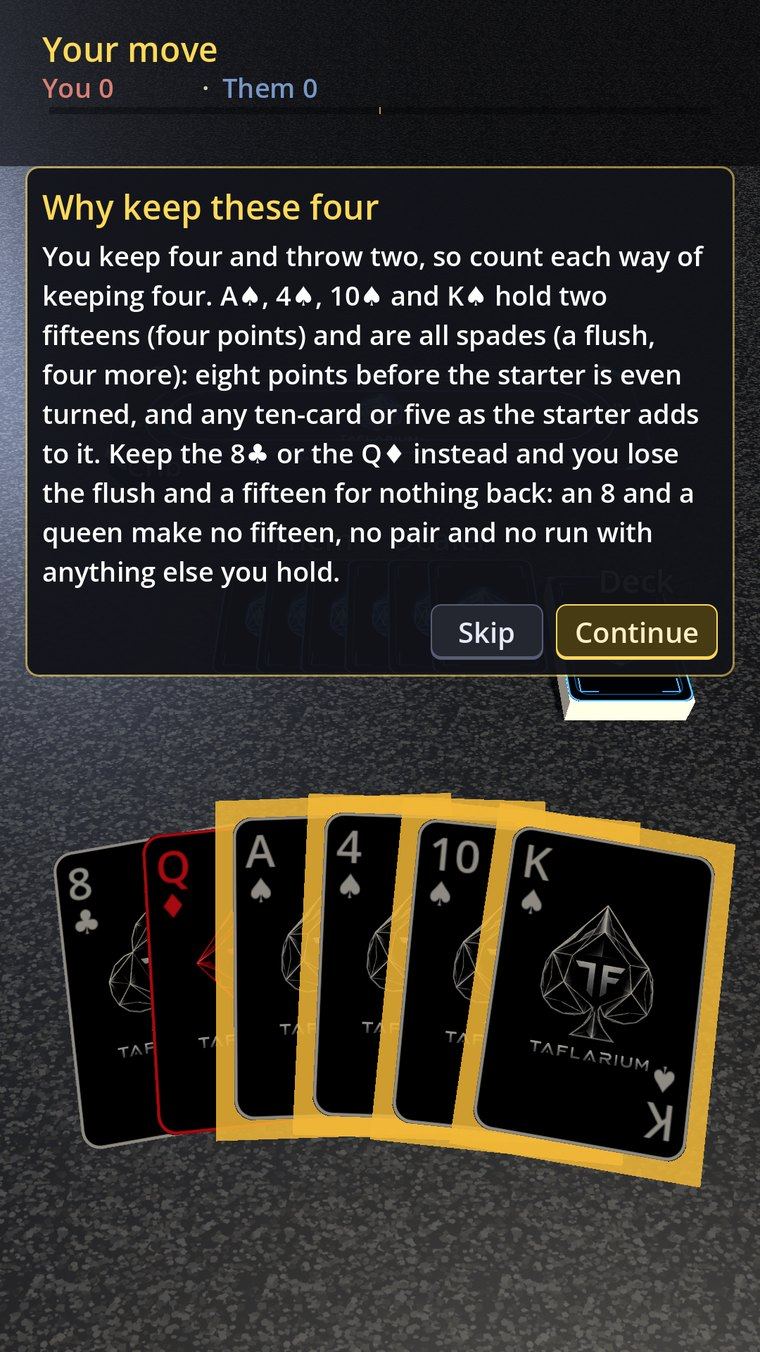
The tutorial teaches the scoring on the six cards in your hand before it asks you to keep any of them, explains the throw, the lead and every reply, and pauses after each of the three counts at the show with the cards still on the table. It is one real hand, with the deal fixed so every lesson comes out the same way.

The Cribbage tutorial with six cards held and the four spades lit, under a coach panel titled Why keep these four that counts the fifteens and the flush in the hand.
The tutorial, counting the keep before you throw
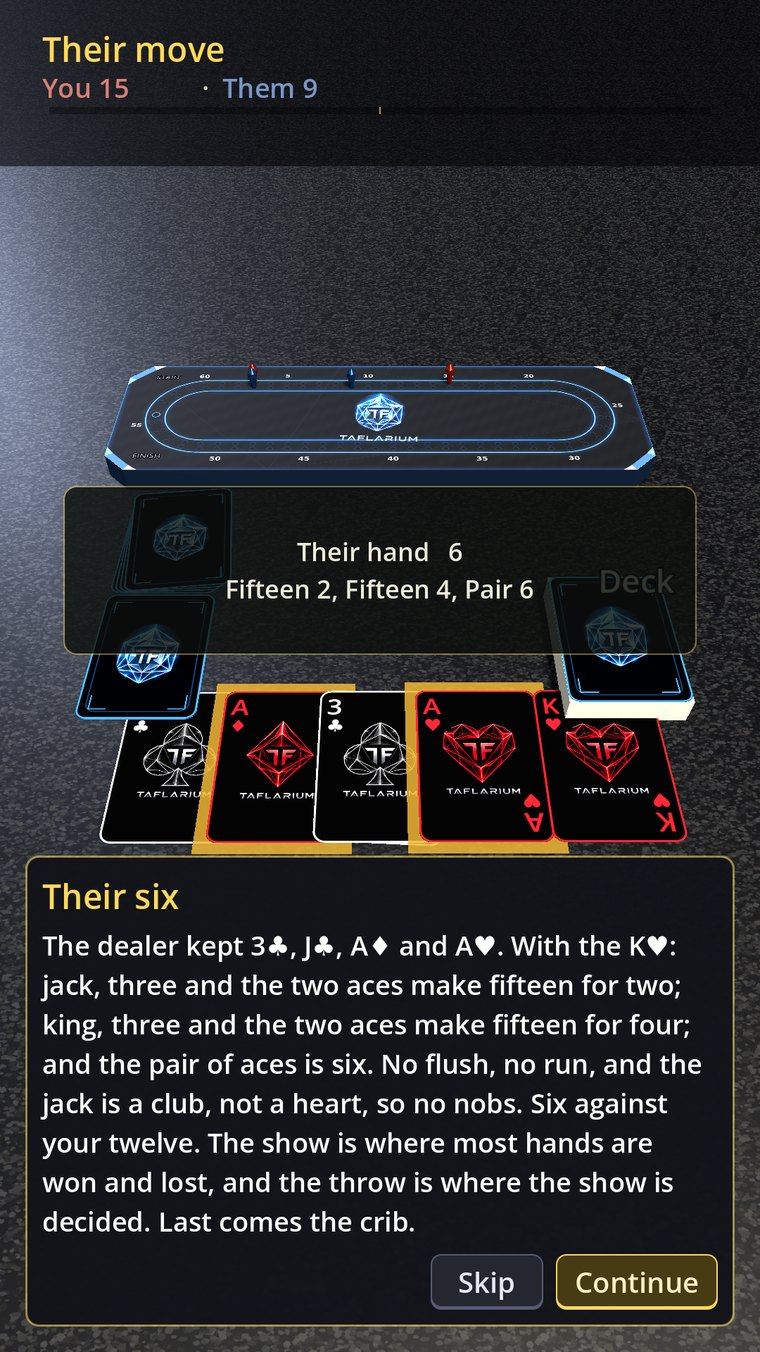
The Cribbage tutorial after the dealer's count: their four cards and the starter laid out under a panel reading Their hand 6, with a coach panel titled Their six explaining each fifteen and the pair of aces.
Their six, explained with the cards still on the table

Status

Where it stands

The game is tested and playable on a computer, but nobody outside the studio has played it yet. There is no release date.

  1. Done

    The ruleset, settled and tested

    Standard six-card cribbage to 121, with a quick game to 61, every choice written down. Two engines (the reference and the one that ships) checked against each other across 250 seeded games and 42,838 plies with no divergence, with the shuffle and the cut made inside the engine so the order of the pack is checked along with the rules.

  2. Done

    The count, checked against every hand

    The show scorer was run over all 12,994,800 hand-and-starter combinations and matches the published distribution exactly. Under strong play the first dealer wins 54% of games, a game runs a median of nine hands, and about one game in six ends in a skunk.

  3. Done

    Opponents with measured strength

    Four opponents, each ranked by playing it against the reference and against random play, and in the same order on both. Random play is a poor yardstick in cribbage, because its throws are so bad that even the Apprentice beats it 94% of the time. Against the reference the four score 10%, 22%, 50% and 55%.

  4. Now

    A playable build

    The 3D table, the board and the pack in our own design, the tutorial, hotseat and single player, twelve languages. This is the build the screenshots on this page come from, and it is being played and fixed daily.

  5. Next

    Playtesting, then the release build

    Testers will tell us what the harness cannot: whether throwing feels right on a phone, and whether the count is easy to read. Then the Android release build.