Taflarium

In development · Android

Mancala

One of the oldest families of board games still played, and the fourth of our Ancestral Relics. Lift the seeds out of one of your houses and drop them round the board, one per bowl. Where the last seed lands decides what happens next: another turn, a harvest, or nothing.

The game

Sow, gather, store

Six bowls in front of you, six in front of your opponent, and a store at each end. On your turn you scoop up every seed in one of your own houses and sow them round the board one at a time, dropping one into your store as you pass it and skipping your opponent's.

Two things can happen when you run out of seeds. If your last one falls in your own store, the turn is still yours, and a well-counted chain can be four or five sows long. If it falls in an empty house of your own, you gather that seed and everything in the house facing it. The rules take a minute to learn, and counting ahead accurately takes much longer.

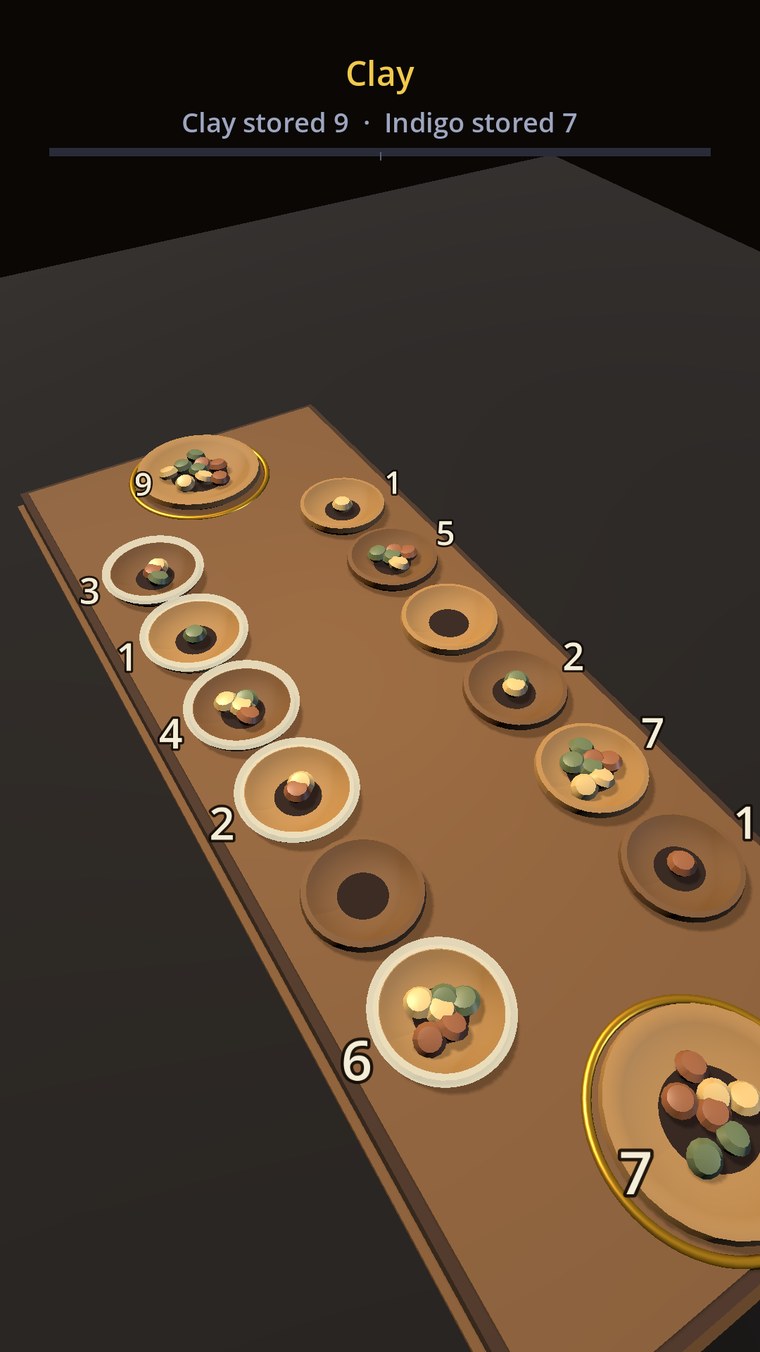
A Mancala game in progress on a carved wooden board: twelve turned bowls holding coloured seeds with their counts beside them, the sowable houses ringed in light, and a larger store at each end.
Mid-game, with every legal sow ringed

The rulesets

Three traditional rulesets

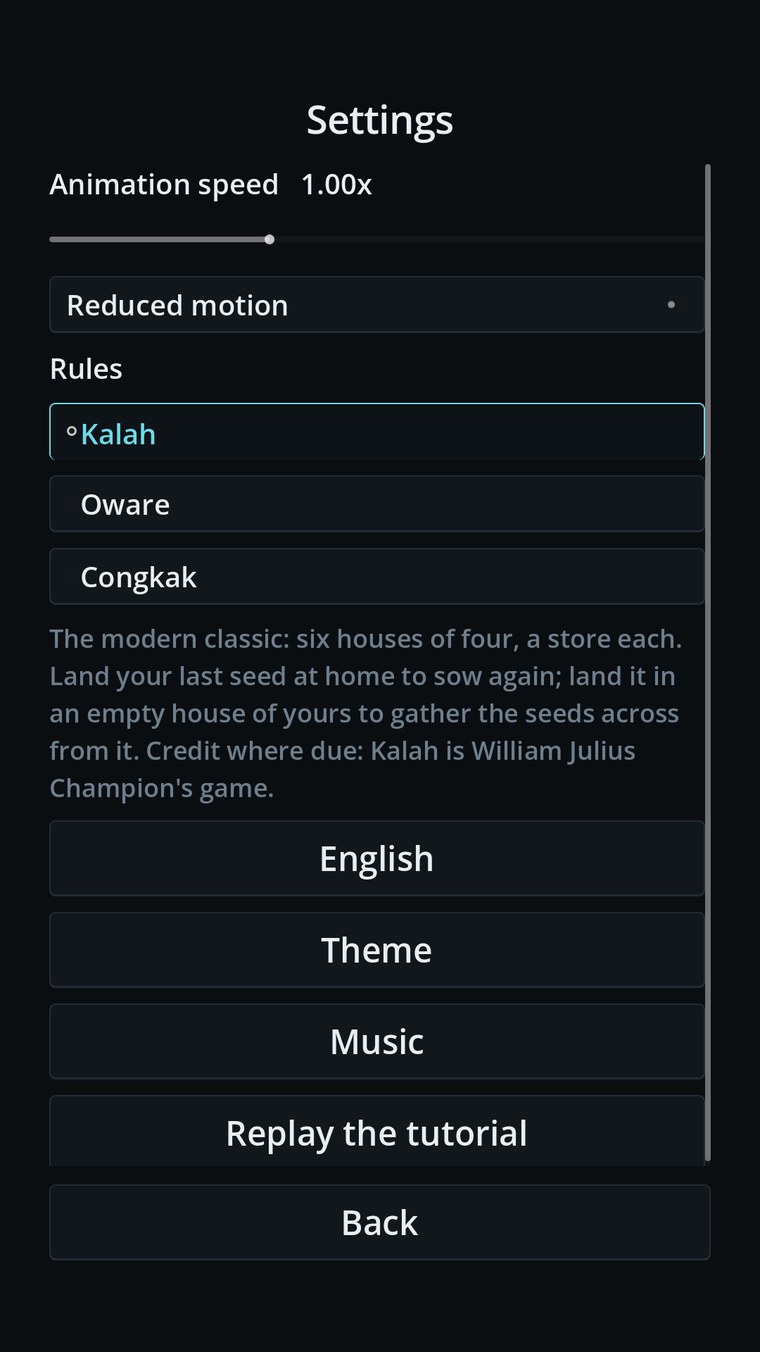
"Mancala" is the name of a family of games, and the versions differ a lot. We included three of them, chosen in Settings. Each is tested the same way, and each is credited to the tradition or person it comes from.

The Mancala settings screen: a Rules section offering Kalah, Oware and Congkak, with Kalah selected and a note beneath it explaining the ruleset and crediting William Julius Champion.
The ruleset switch, with its credit underneath

Kalah

The one most people mean when they say mancala: six houses of four a side, a store each, sow again when you land at home. It is a modern game rather than an ancient one, invented and sold in the twentieth century by William Julius Champion, Jr., and it is the default here because it is the version players already know, and the one the tutorial teaches.

Oware

The Akan game, under Abapa tournament rules. The stores are only score trays, and no seeds are ever sown into them. You harvest by landing on a house that reaches two or three seeds and chaining backwards, you must feed a starving opponent if you can, and a move that would take everything they own takes nothing instead.

Congkak

The Malay game, on seven houses of seven. Its main feature is the relay: land your last seed in an occupied house and you pick that whole house up and keep going, on either side of the board, until you finally land somewhere empty. Turns run long and the board empties fast.
Every rules choice is written down with its source and its reasoning before it is coded, and none of the traditions or authors above endorse this game. We play their rules and credit them.

The board

Seeds land one at a time

When you sow, the seeds go round one at a time, bowl to bowl, and each count goes up as its seed drops in. A harvest moves the seeds to your store together.

An earlier build showed the result instantly. Watching each seed land is slower, but the skill of the game is counting ahead to where the last seed falls, and that is easier to learn when you can see a sow happen. The bowls are turned on a lathe by the engine when the board loads, so the table can be reshaped by editing data.

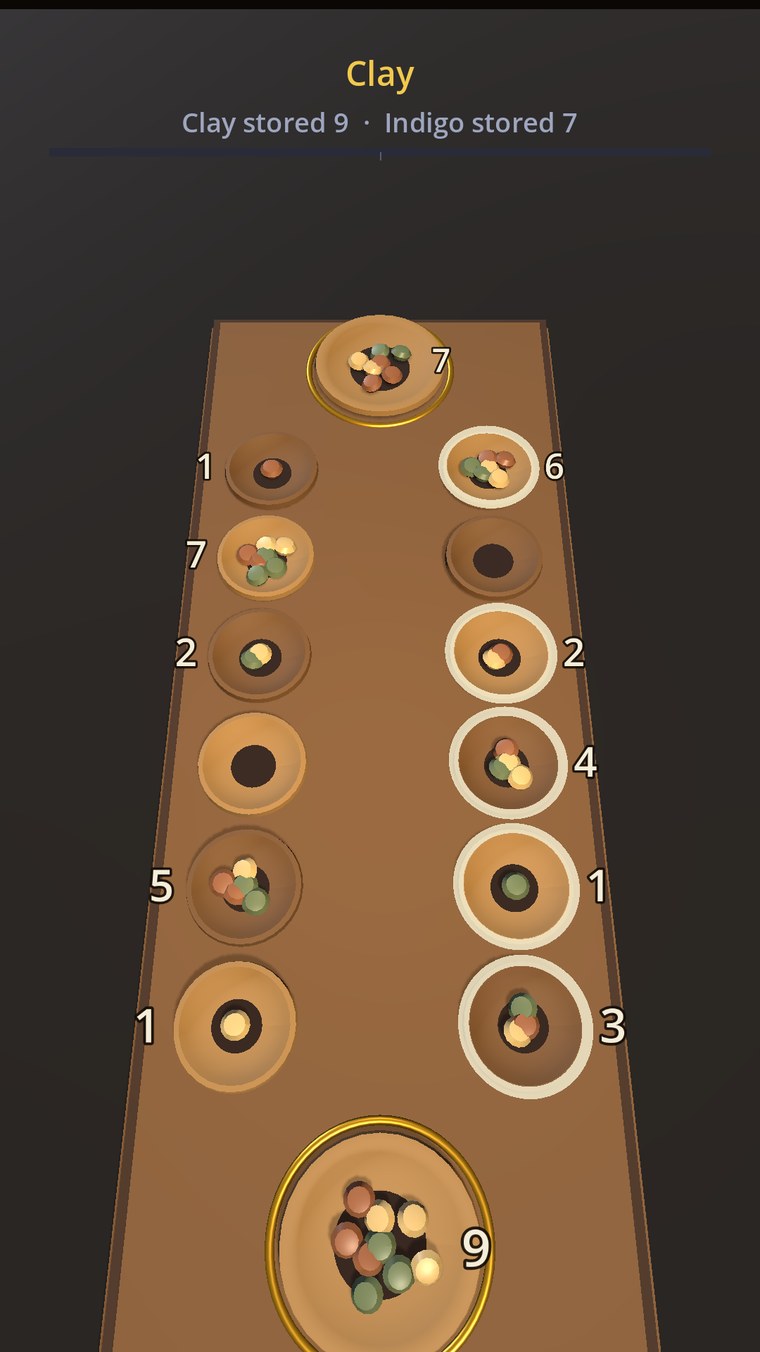
The Mancala board seen from a turned angle, the carved slab and its turned bowls standing in relief with the gilded rings around the two stores.
The same position, from the other side of the table

In the box

What you get

3Rulesets, each tested
48Seeds on the Kalah board
4Opponents, ranked by measured strength
12Languages at launch

Opponents at four strengths

Four opponents, from the Gleaner to the Elder, each ranked by how it actually plays. The gentlest wins two games in five against random play; the strongest wins nineteen in twenty, and looks at what you can do next before it decides what it does now.

Yours to play

Hotseat with a friend on one device, or single player against the AI. No account, no connection, no telemetry.

Learn it from an empty board

The tutorial starts with nothing on the table and fills it in: your houses, their houses, the stores, then one sow at a time. Fifteen short steps, each with one idea in it, and a worked harvest at the end.

Status

Where it stands

The game is tested and playable, but it is not in a store yet, and there is no release date.

  1. Done

    Three rulesets, settled and tested

    Every rules choice written down with its source, and two engines (the reference and the one that ships) checked against each other across 250 seeded games and 15,861 moves, all three rulesets included, with no divergence.

  2. Done

    Opponents with measured strength

    Four opponents, ranked in the same order against both of our yardsticks (our own reference player and random play). Measuring Congkak turned up something useful: the player who starts wins 60.3% of random games and only 30.7% of strong ones, so the game alternates who opens.

  3. Done

    A playable build

    The carved board of turned bowls, seeds that land one at a time, the tutorial, hotseat and single player, twelve languages. This is the build the screenshots on this page come from.

  4. Now

    Playtesting, then the release build

    Testers will tell us what the harness cannot: whether counting a sow ahead feels good on a phone. Join the testers list if you want to be one of them. Then the Android release build.

  5. Next

    What players ask for

    Bao is written up but not included. It needs a four-row board and its own engine, and we only ship rules we have tested. The game is structured so online play can be added later, but it has not been built.