Dohyō
The ring itself: clay, straw bales, and the offerings buried at its centre. East against West.
Iwayama · Kurokaze · Iwane · Sazanami
Closed testing · Android
A two-player strategy game with six creature archetypes on a ringed board. You move, shove and strike, and a round ends when someone holds the centre or the other side has nothing left to send. A game takes about ten minutes, and none of four thousand test games ended in a draw.
The game
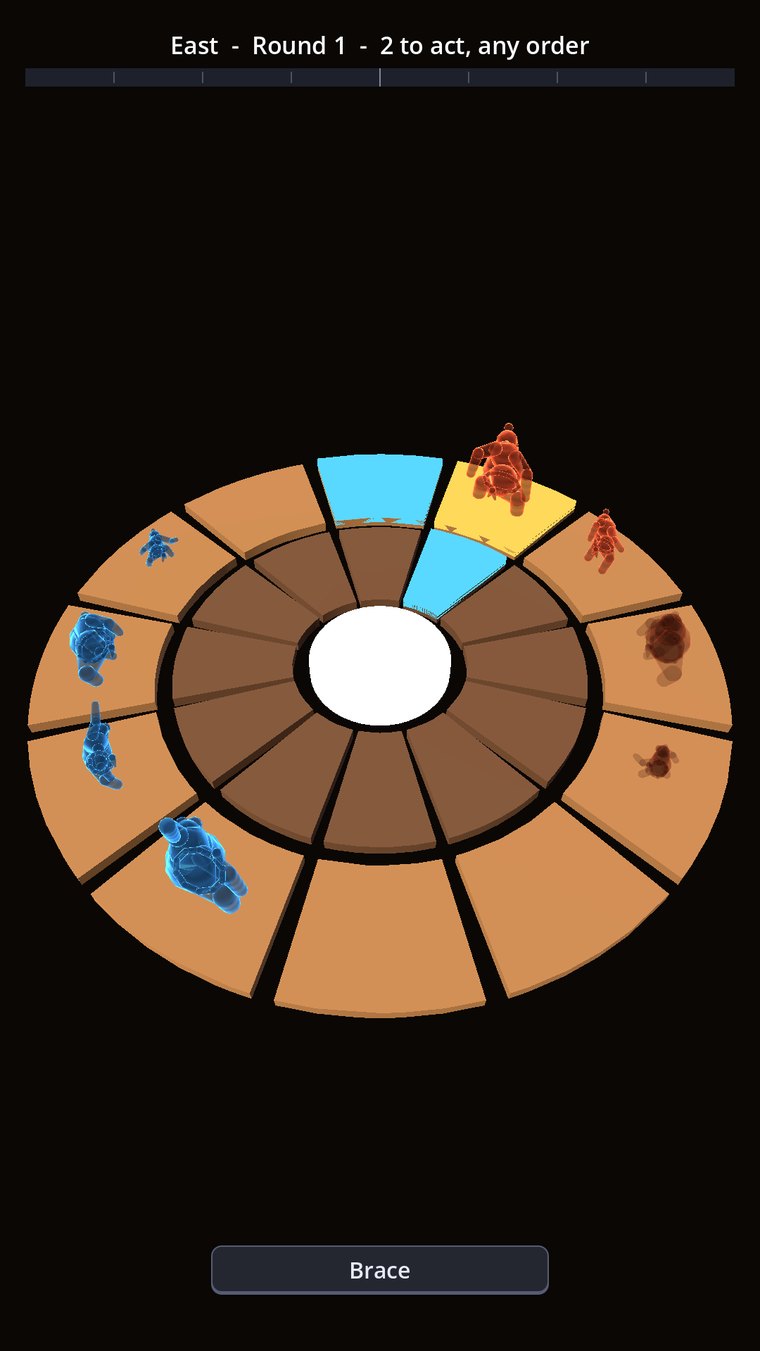
Each time you activate a piece, you choose between getting somewhere and putting pressure on. Move repositions along the ring's adjacency graph. Shove displaces an opponent, often into worse ground rather than off the board. Strike resolves against the defender's guard, and the margin decides whether anything happens at all.
There are forty to sixty legal actions each time, so there is rarely one obvious move. Games still finish quickly: the median game is decided in six rounds.
The roster
Breaker, Colossus, Courser, Sentinel, Stalker and Warden. They differ in movement, guard and the force they bring to a strike, and they were tuned until no single one was worth more than another by more than a few points.
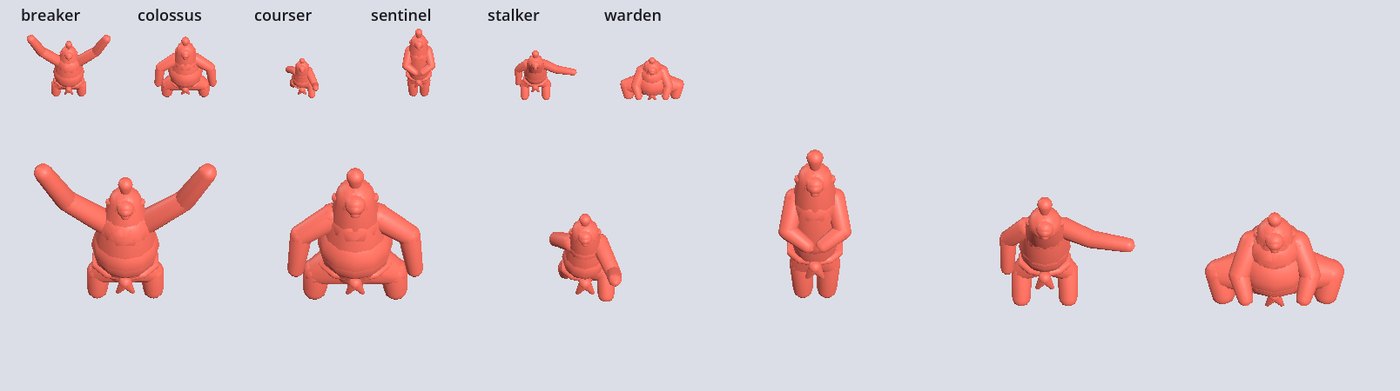
The Warden's movement was raised from one to two during tuning. That narrowed the spread between archetypes from 7.6% to 4.5%. The piece had been short of movement rather than strength. How often a piece survived turned out to be a misleading measure; the reliable one was how much a side lost by playing without it.
Themes
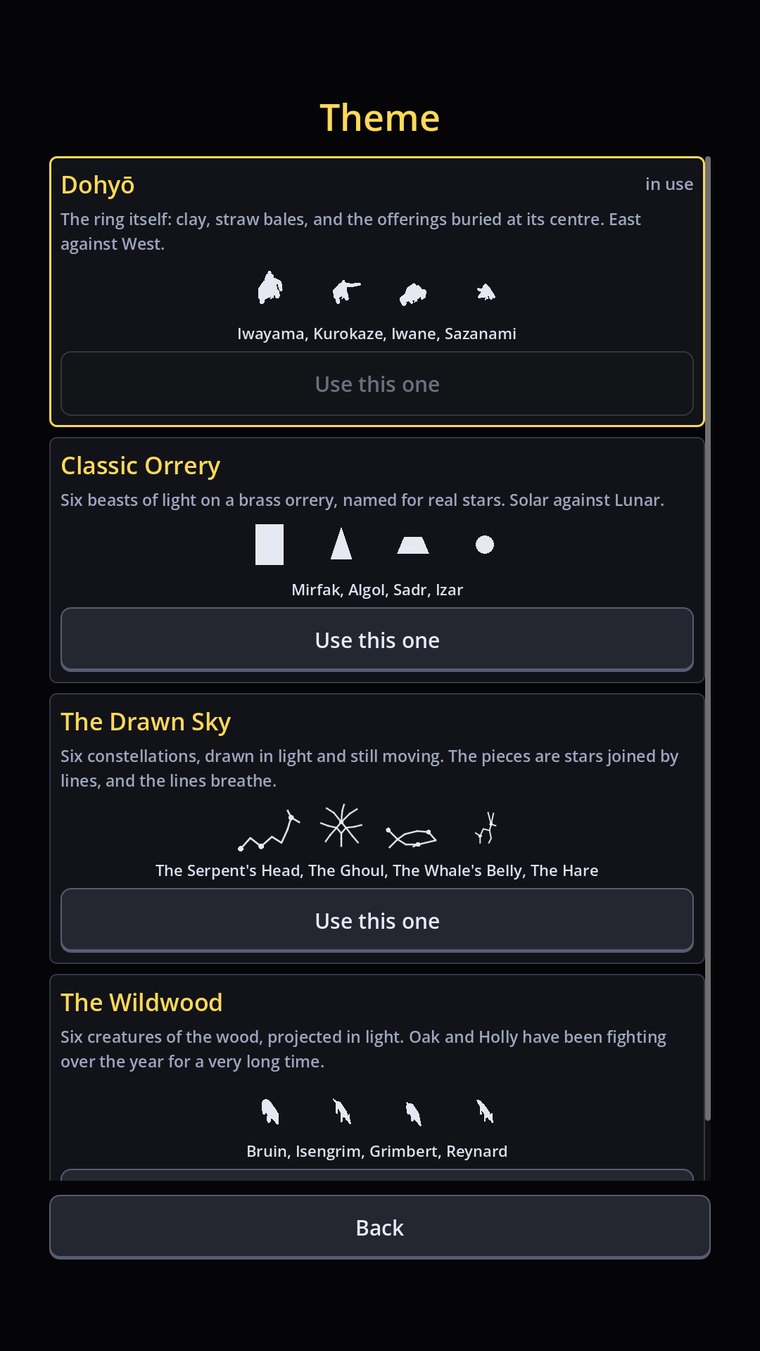
A theme is a data file holding every name, model, colour and line of text in the game. The rules never see any of it. Switch theme and the board, the creatures and the wording all change while the rules stay the same.
The ring itself: clay, straw bales, and the offerings buried at its centre. East against West.
Iwayama · Kurokaze · Iwane · Sazanami
Six beasts of light on a brass orrery, named for real stars. Solar against Lunar.
Mirfak · Algol · Sadr · Izar
Six constellations, drawn in light and still moving. The pieces are stars joined by lines, and the lines breathe.
The Serpent's Head · The Ghoul · The Whale's Belly · The Hare
Six creatures of the wood, projected in light. Oak and Holly have been fighting over the year for a very long time.
Bruin · Isengrim · Grimbert · Reynard
In the box
Eight opponents, ranging from a 7.3% to a 54.0% win rate against our reference player. The weakest is good for learning, and the strongest is hard to beat.
Hotseat on one device, or single player against the AI. No account, no connection and no telemetry, so it works anywhere, including offline.
A ten-step scripted tutorial, and a Pieces & Dice reference you can open mid-game.
Closed testing
Dohyō has gone from 1.0.1 to 1.0.6 in closed testing. Four of the five updates came from testers' reports.
Twelve rows of settings became four controls: a style (seven of them, including Rock, Jazz and a Tsugaru-jamisen played on a shamisen), one mood, how much of the music repeats, and a three-word soundtrack code you can write down or pass on.
Pieces that had already acted were dimmed and made mostly transparent at once, so they almost disappeared. They keep their colour now. A placed piece is no longer drawn back in your hand, "Who opens" is now Random, Me or Opponent, and the Yokozuna has stopped rushing the centre on round one.
Its two ring colours were almost identical, so the board looked like one dark shape. Oak-leaf litter and holly green now alternate, with a lit clearing at the centre. A new setting lets the opponent move first.
Lists could be scrolled with a mouse wheel but not a finger, so only the top two pieces in the custom roster could be picked. All five scrolling screens now work by touch. The opponent also waits for you to close a result before it replies.
The result used to stay over the board and hide a piece's stats when you tapped it. Eleven languages also lost the last of the "killed" wording.
Next on the list is a strike preview, so you can see the numbers before you commit to a strike. The full story is in the devlog.
Status
The game is built and in closed testing on Google Play, now at version 1.0.6. A public release date depends on how the test goes.
Board, actions, combat and scoring settled and measured. Zero draws, six-round median, first player at 52.6% ±1.5%, archetypes within 4.5% of each other.
A reference implementation and the shipping port, checked against each other across 250 seeded games and 31,324 plies with no divergence.
Eight opponents tuned and ranked, eight challenges verified to sit inside their difficulty band, the draft costs fitted from 24,000 mixed-roster games.
The board view, touch input and the HUD, running on a phone, to find out what simulation cannot: whether it feels good to play.
Testers have reported problems that the simulations could not find, and five updates have followed. If you would like to help, join the testers list.