Opponents at four strengths
Four opponents, each ranked by how it actually plays. The gentlest loses in about eighteen moves and is good for learning. The strongest has not yet let our benchmark king reach a corner.
In development · Android
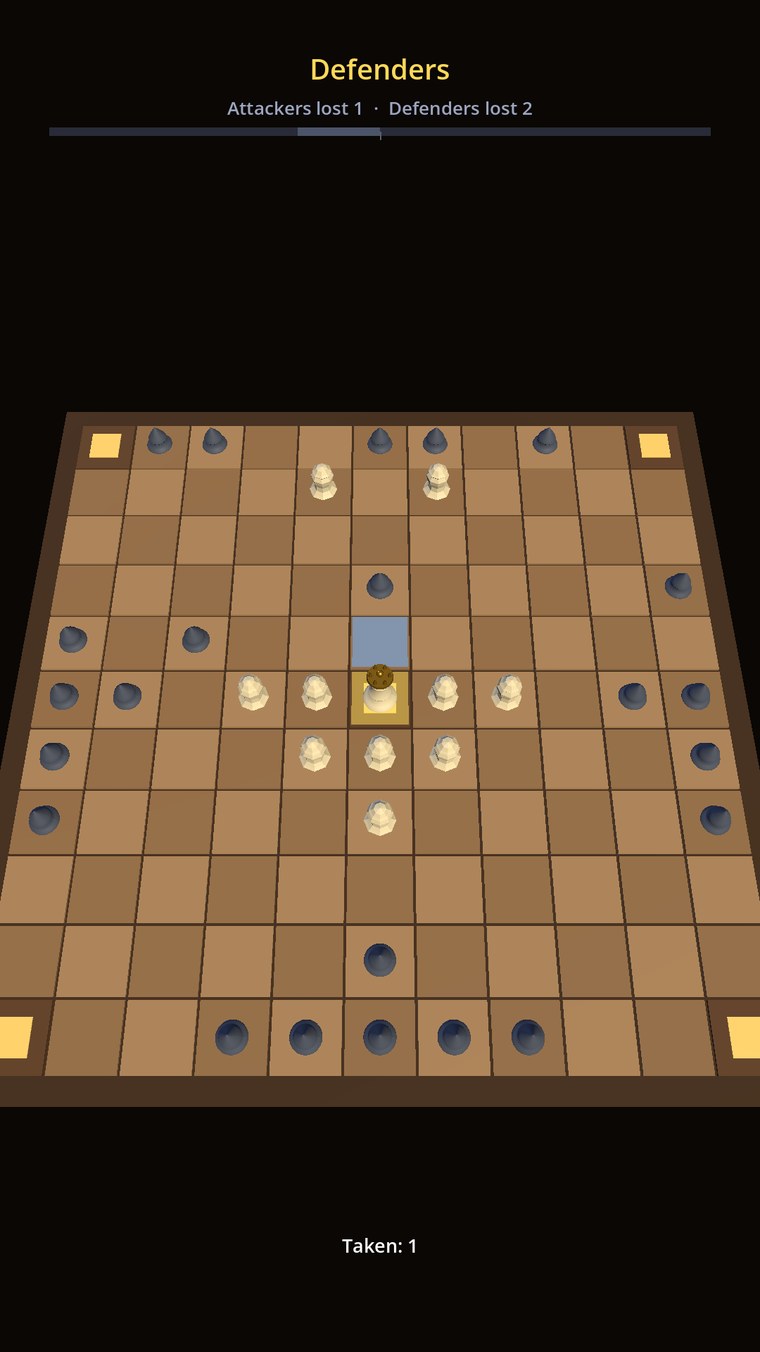
The Viking siege game, and the first of our Ancestral Relics. One king and twelve defenders hold the centre of an 11×11 board; twenty-four raiders hold the edges. He is trying to reach a corner, and they are trying to wall him in. The two sides are deliberately unequal.
The game
Every piece moves like a chess rook, any distance along a rank or file. You capture by sandwiching: close your pair around a raider or a defender and it is lifted from the board. The corners belong to the king alone, and they count as one of your pieces: an enemy trapped against a corner is taken as if by a second soldier.
The sides want different things. The king wins the moment he steps into a corner; the raiders win by sealing him in so completely that no gap remains. Playing the king's side and playing the raiders feel like two different games, and each is worth learning.
The pieces
A raider's forged helm, a housecarl cut in eight flat facets, and the king under his gilded crown. The three shapes are easy to tell apart by outline and size alone, without relying on colour.
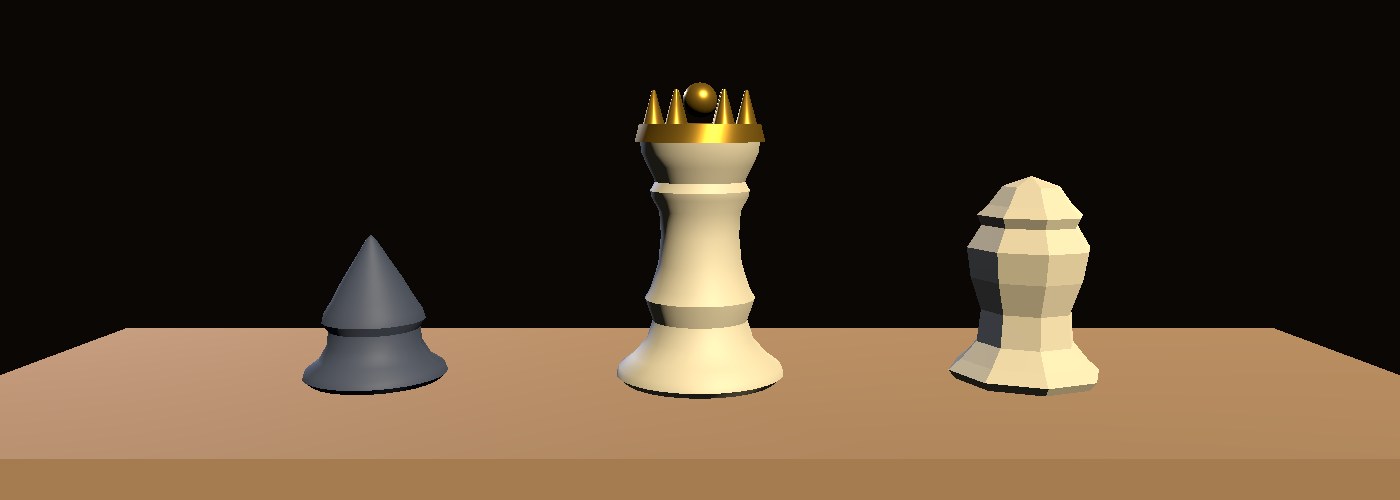
The pieces are stored as lathe profiles in the theme file, and the engine turns them into 3D shapes when the board loads. The housecarl's facets come from an eight-step lathe left unsmoothed. A future theme can reshape the whole set by editing data, the same separation that gives Dohyō its four worlds.
The board
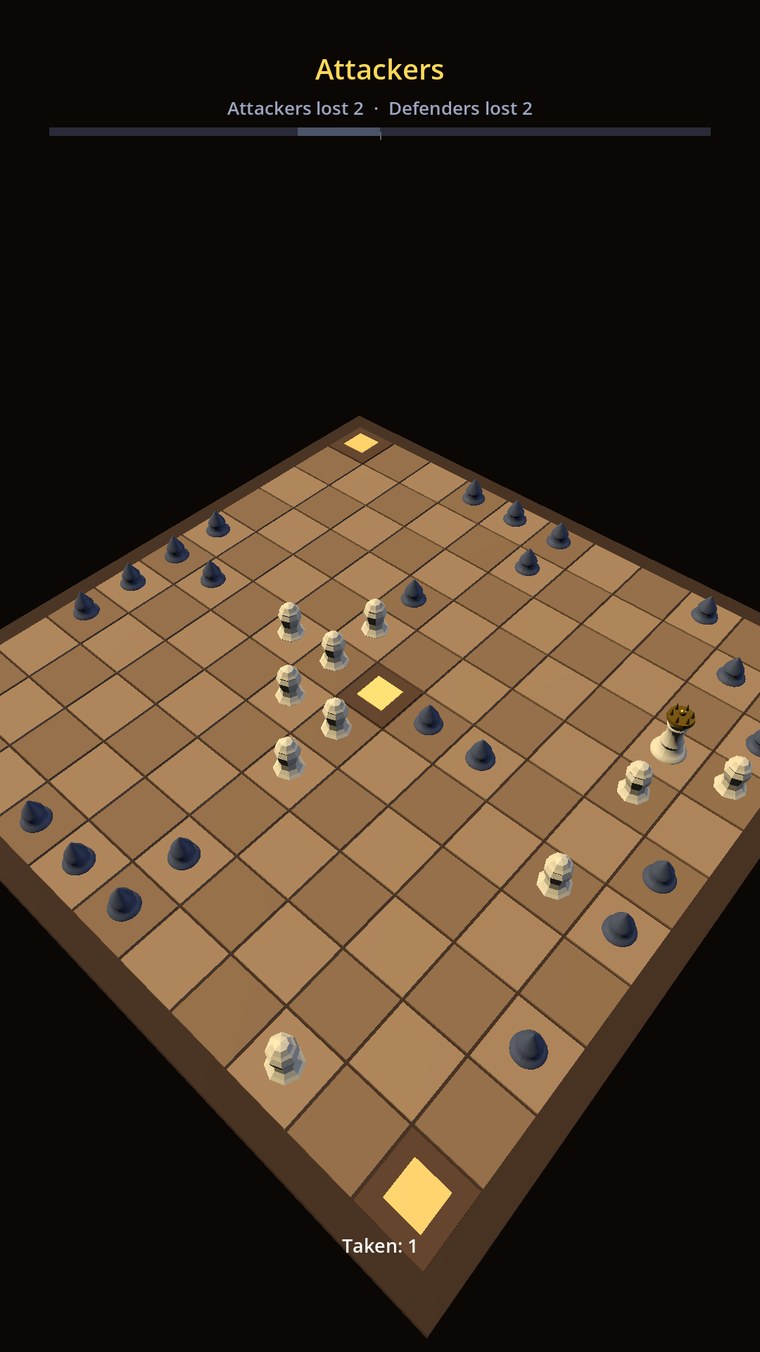
Drag anywhere off a piece and the board turns. You can look at it from any side, as you would a real table, then tap a piece and carry on. A tap selects and a drag turns, so the two never get confused.
This helps more here than in most games, because the defenders look outward from the centre and the raiders look inward from the edges. Whichever side you play, you can see the board from the other one.
In the box
Four opponents, each ranked by how it actually plays. The gentlest loses in about eighteen moves and is good for learning. The strongest has not yet let our benchmark king reach a corner.
Hotseat with a friend on one device, or single player against the AI. No account, no connection, no telemetry.
A scripted tutorial walks you through moving, capturing, the corners and the king's escape, and how each side thinks about the board.
Status
The game is tested and playable, but it is not in a store yet, and there is no release date.
Every rules choice written down with its reasoning, and two engines (the reference and the one that ships) checked against each other across 250 seeded matches and 68,011 moves with no divergence.
Four opponents, each ranked by playing it. The strongest works out the king's best reply before it moves, and has kept him from a corner in every benchmark game so far.
The board you can turn, the carved set, the tutorial, hotseat and single player, twelve languages. This is the build the screenshots on this page come from.
Testers will tell us what the harness cannot: whether the game feels good on a phone. Join the testers list if you want to be one of them. Then the Android release build.
The game is built to support versus play beyond one device. Online matchmaking gets built when enough players want it built.