Taflarium

In development · Android

Royal Game of Ur

A race game from ancient Mesopotamia, and the second of our Ancestral Relics. Seven counters a side, twenty squares, four lots to throw, and one road down the middle that both of you have to travel. The shared stretch is where counters get knocked back.

The game

Throw, move, and mind the middle

Each turn you throw four lots, every one lands marked or blank, so a throw is anything from nought to four, and move one counter exactly that far along its road. Your counters start on your own row, turn onto the shared middle for eight squares, and come home through the last two on your side. Bring all seven off the board and the race is yours.

Five squares carry a rosette. Land on one and you throw again. The rosette in the middle of the shared road is also safe ground: a counter standing on it cannot be taken, and while it sits there it blocks your opponent's road. Everywhere else on the middle, landing on an enemy counter sends it home to start again, and, in this house, earns you another throw. A nought is thrown again, once.

A Royal Game of Ur match on a wooden board: light and dark counters along the three rows, a light counter selected with its destination lit, and a throw of three shown above the board.
A throw of three, and a counter chosen to spend it

The rules we play

Our own rules, and whose we borrowed from

Nobody knows exactly how the game was played. The surviving boards fix the road, the counters and the lots, and everything else is reconstruction, which several people have attempted. We kept what the board itself dictates, added two rules of our own, and measured what they did to the game. The published reconstruction is in the game too, for anyone who wants it.

House rules — the default

Seven counters, the short road of fourteen squares, four lots, rosettes safe with an extra throw, an exact throw to bear off, plus two of ours: a nought is thrown again, once, and driving a counter out earns another throw. This is what the tutorial teaches.

Finkel rules — optional

Irving Finkel's reconstruction for the British Museum (2007), as published: the same board and lots, but a nought loses the turn and a capture earns nothing. One switch in Settings.

The quick game

Either set with five counters a side. The same rules with about a third fewer moves, for a shorter sitting.

Why those two rules: we ran the harness over ninety-six variations of the game (rosettes safe or not, extra throw or not, what a nought does, three lots or four, five counters or seven). The advantage of going first stayed within the noise in every version, so it was not worth designing around. What the rules do move is the dead turn, where a nought or a blocked throw means you do nothing: one turn in twelve under the Finkel rules, one in forty under ours. The capture throw rewards fighting over the shared road and shortens the game by about a tenth. The idea of a throw for a capture comes from the Blitz rules on RoyalUr.net; the crossing road and three-dice game of James Masters is on our list, once we have verified its path square by square. Stacking, backward moves and the tablet's gambling stakes are in no version.

Irving Finkel, the British Museum, James Masters and RoyalUr.net are named here to credit their work. None of them has any connection with this game, and none has endorsed it.
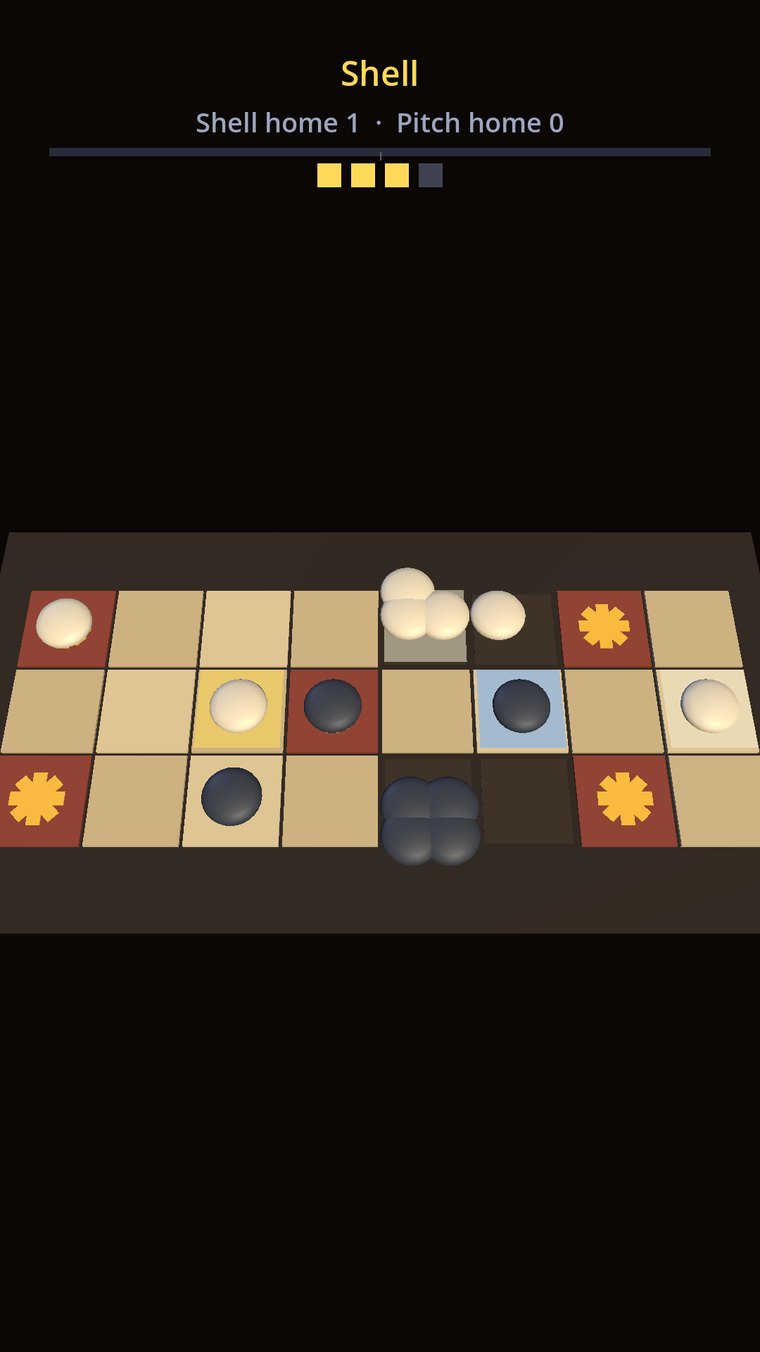
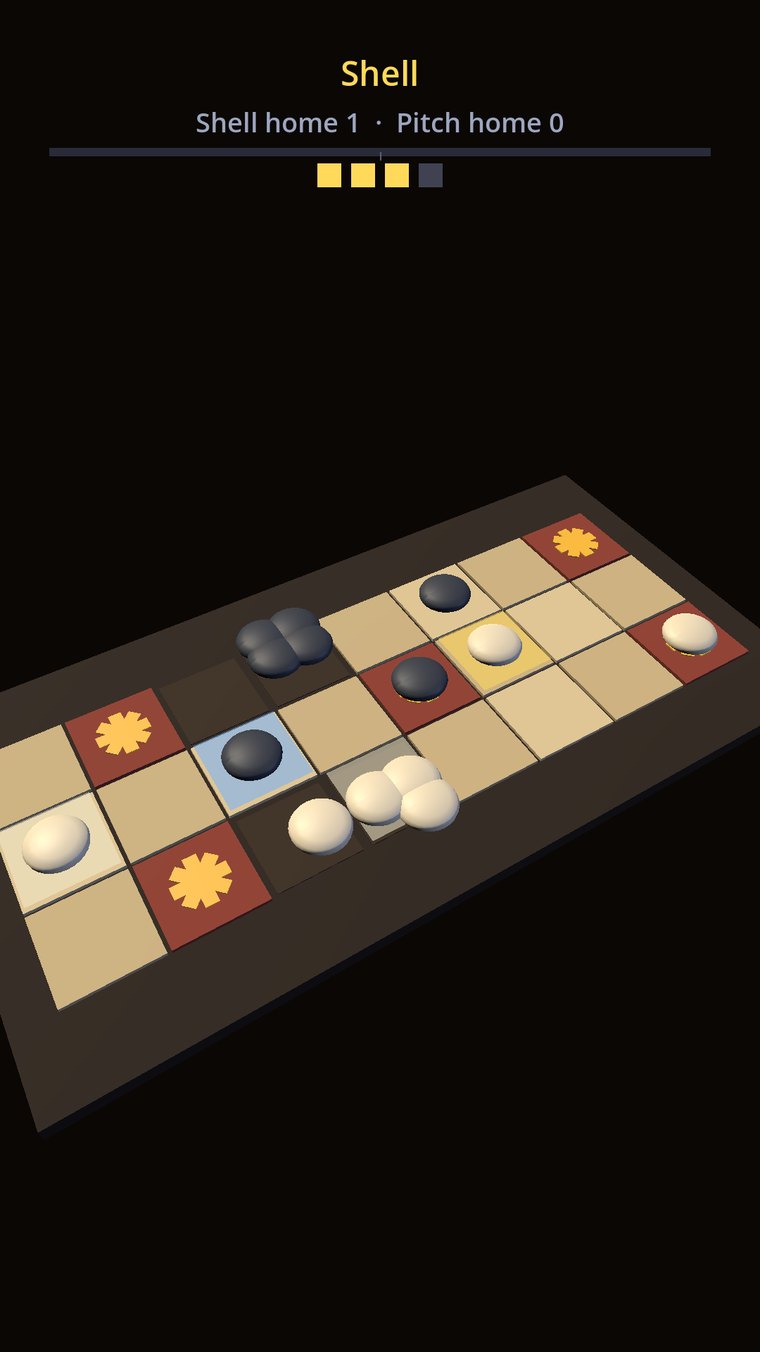
The Royal Game of Ur board seen from a turned angle mid-race, counters standing in relief on the wooden squares with the rosettes picked out in red and gold.
The same race from the other side of the table

The board

Turn the table

Drag anywhere off a counter and the board turns, as the Hnefatafl board does. You can look down the shared road from your opponent's end, then tap a counter and carry on. A tap selects and a drag turns.

The counters are lathe profiles in the theme file, turned into 3D shapes by the engine when the board loads. For now they are pale and dark discs, and a future theme can reshape the set without touching a rule.

In the box

What you get

14Counters on a board of twenty squares
5Rosettes, one of them on the shared road
4Opponents, ranked by measured strength
12Languages at launch

Opponents at four strengths

Four opponents, each ranked by how it actually plays. The gentlest wins fewer than half its games against random play and is good for learning; the strongest has not yet lost one to random play, and takes 48.3% against our reference player.

Yours to play

Hotseat with a friend on one device, or single player against the AI. No account, no connection, no telemetry.

Learn the road in minutes

A scripted tutorial walks you through the throw, the road, the rosettes, driving an enemy out, the nought you throw again and bearing off, with the throws fixed in advance so every lesson comes out the same way.

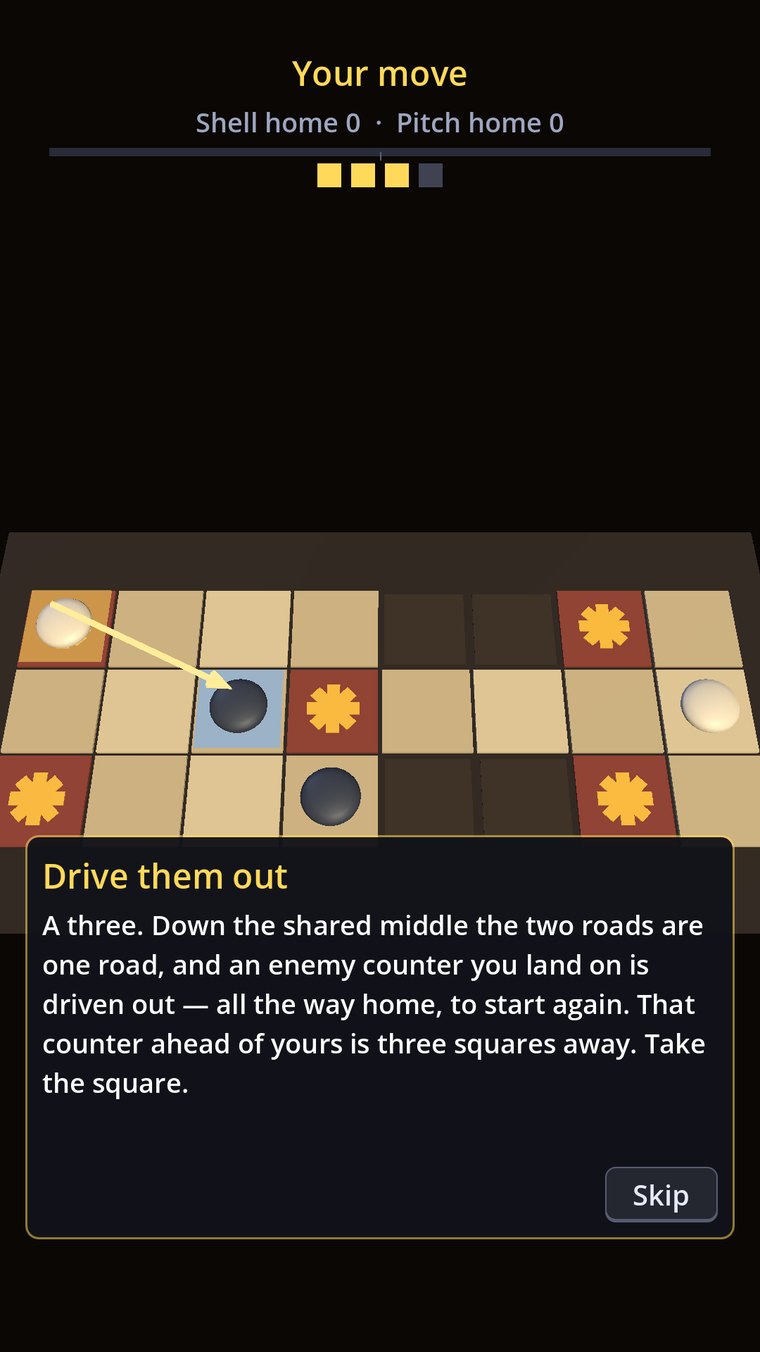
The Royal Game of Ur tutorial mid-lesson: an arrow from a light counter to an enemy dark counter three squares ahead, with a coach panel titled Drive them out explaining the capture.
The tutorial, teaching a capture
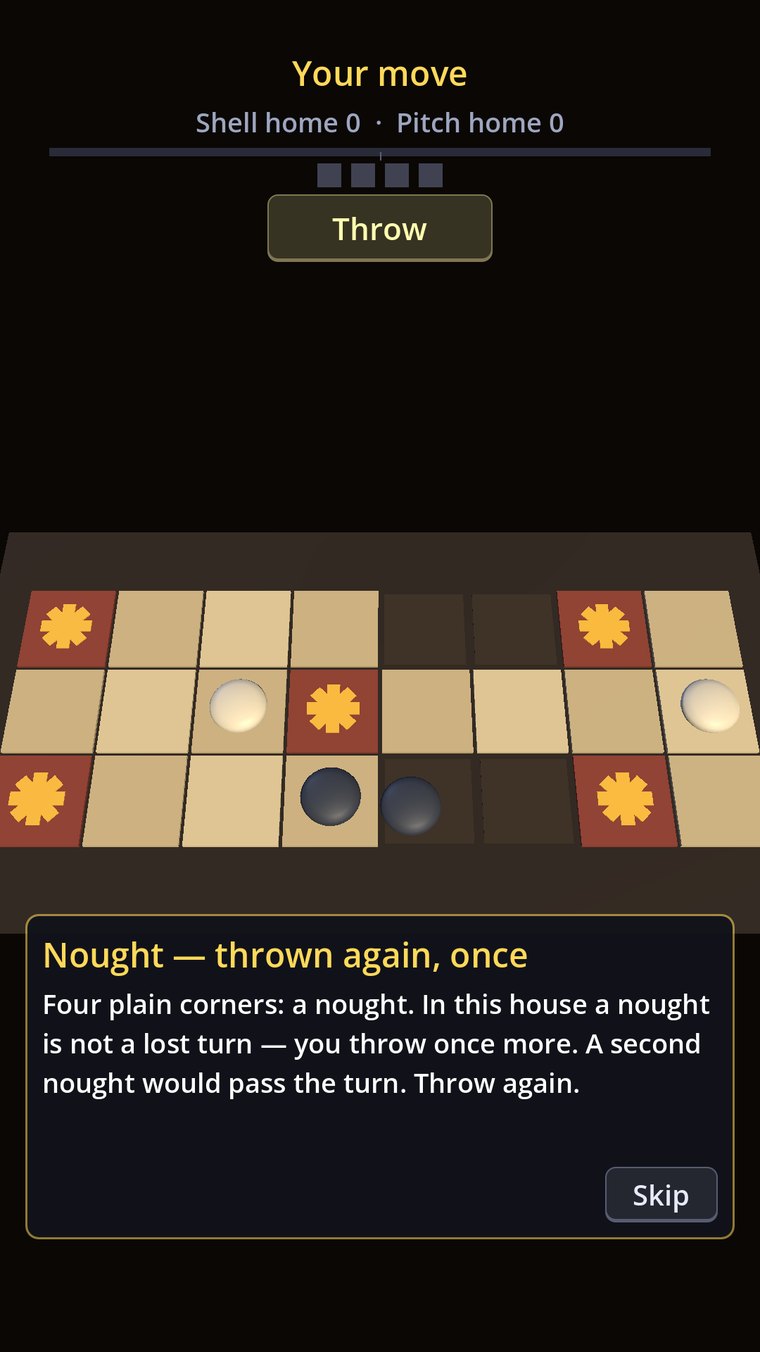
The Royal Game of Ur tutorial showing four blank lots above the board and a coach panel titled Nought — thrown again, once, with the Throw button offered again.
Four plain corners, and the throw comes back

Status

Where it stands

The game is tested and playable, but nobody outside the studio has played it yet. There is no release date.

  1. Done

    The ruleset, settled and tested

    Every rules choice written down with its source or its measurement, and two engines (the reference and the one that ships) checked against each other across 250 seeded games and 63,536 plies, all four rule sets, with no divergence. The throws are made inside the engine, so the dice (and the nought thrown again) are checked along with the moves.

  2. Done

    Balance, measured

    Two thousand games per rule set under strong play: the opener wins 50.5%, a game runs a median of 233 actions with five or six captures, and a dead turn comes round once in forty rather than once in twelve. There is enough capturing to make the race competitive, and few enough dead throws to keep it moving.

  3. Done

    Opponents with measured strength

    Four opponents, each ranked by playing it against the reference and against random play, and in the same order on both. The one-move evaluator used in our other games works here too: under our rules it beats random play 99.7% of the time.

  4. Now

    A playable build

    The board you can turn, the turned counters, the tutorial, hotseat and single player, twelve languages. This is the build the screenshots on this page come from.

  5. Next

    Playtesting, then the release build

    Testers will tell us what the harness cannot: whether the game feels good on a phone. Join the testers list if you want to be one of them. Then the Android release build.